



> Events
Enescu’s Music at the “Eufonia” Festival. An Exuberant and Evocative Evening in Warsaw
I gladly
accepted the invitation to the 7th edition of the Eufonia
International Festival of Central and Eastern European Music, organized by
Poland’s National Centre for Culture. This year’s event takes place between
November 13th and December 7th. Initially held exclusively in Warsaw, the
festival has, for the second consecutive year, expanded to several major cities
in Poland. Thus, in the current edition, concerts originally programmed for the
capital are also being presented in Katowice, Opole, Olsztyn, Kraków, Łódź,
Gdańsk, Lusławice, and Dębica (the birthplace of Krzysztof Penderecki). A
significant premiere this year is the festival’s first expansion beyond
Poland’s borders: Eufonia has reached Bucharest thanks to the 2024–2025
Romania–Poland Cultural Season, organized on the Romanian side by the Ministry
of Culture and the Romanian Cultural Institute, and on the Polish side by the
Ministry of Culture and National Heritage together with the Adam Mickiewicz
Institute, in cooperation with the Polish Institute in Bucharest. The November
28th concert performed by the Bucharest Philharmonic under the baton of Gabriel
Bebeșelea was included in the Festival’s programme before the ensemble
presented the (nearly identical) programme in Kraków and Warsaw.
Romanian
musical creation has been included în the concerts
of the Eufonia festival since the very first edition, and 2022 marked the first
participation of Romanian artists, through the presence of the Transylvania
Philharmonic Orchestra of Cluj-Napoca, conducted by Gabriel Bebeșelea.
I was present on
that occasion as well, and this year—at the invitation of the National Centre
for Culture in Poland, led by Robert Piaskowski, and through the Adam
Mickiewicz Institute—I chose to attend the concert held on November 29th
in Warsaw. This gave me the opportunity to observe just how much this
ambitious festival has grown, bringing together artists from the countries of
Central and Eastern Europe while embracing a wider scope, including musicians
from the Baltic states, for instance. The 7th edition bears the metaphorical
title “Poświaty i powidoki”, a phrase that could be translated into Romanian as
“Glimmers and Afterimages.” It evokes the echoes and sonic images that, on the
one hand, remain with us long after a concert has ended, and on the other,
continue to inspire new generations of artists—an imprint of history through
the lens of art.
Entitled
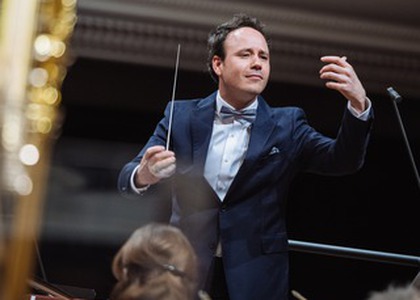
“Exuberance”, the Saturday concert was performed by the Warsaw Philharmonic
Orchestra under the baton of Gergely Madaras, with cellist Tomasz Daroch as
soloist; the institution’s Men’s Choir, prepared by Bartosz Michałowski, also
took part. Presented to a large audience in the
Philharmonic Hall, the programme featured works by three cosmopolitan composers
deeply relevant to their national cultures as well as to universal musical heritage:
Enescu, Kodály, and Weinberg—creators who drew inspiration from their nations’
musical traditions while shaping original and distinctive musical languages.
The concert
opened with George Enescu’s Romanian Poem, Op. 1. Evocative was my first
thought as I listened to the opening chords, with the cellos at the
forefront—an impression that stayed with me throughout the evening. Excellently
performed by the Polish orchestra under Madaras, the score unfolded in all its
splendor, highlighted by a moving flute solo played from the balcony, playful
folkloric moments, and the majestic sonorities of the royal anthem. These
showcased not only the ensemble’s timbral richness and power but also its
versatility, shifting seamlessly between passages of overwhelming lyricism,
folk-infused sections, and a solemn, imposing finale that alternated hushed,
chamber-like nuances with orchestral tuttis in full fortissimo. The Warsaw
Philharmonic Men’s Choir impressed with its cohesive, homogeneous sound and
precise attacks, responding impeccably to the conductor’s gestures. I
appreciated Gergely Madaras’s decision to place the intermission after this
work, allowing the audience to savor the echoes of this extraordinary score,
which lingered long within us.
The second half
began with Mieczysław Weinberg’s Cello Concerto, Op. 43, composed in
1948—a difficult year in the composer’s life, marked by the assassination of
his father-in-law on Stalin’s orders and the beginning of the Soviet dictator’s
persecution of the composer himself. The concerto was only premiered in 1957,
after Stalin’s death allowed for slightly greater artistic freedom. Structured
in four movements, the work includes a striking cadenza at the end of the
third—exceptionally extensive, giving the impression of a standalone piece for
cello, delicately accompanied by part of the orchestra. The concerto conveys a
wide range of emotions and was rendered with remarkable expressivity by Polish
cellist Tomasz Daroch, principal cellist of the NFM Leopoldinum Orchestra, active
in various chamber ensembles, and pursuing a solo career. The chamber character
that permeates much of the concerto is intertwined with a sense of nostalgia.
And although the score features expansive moments evoking the bustling
atmosphere of old-time fairs—energetically and impeccably delivered by the
brass parts—the word that best captures this listening experience is once again
evocative. The ending of the concerto was particularly sensitive, with
Daroch’s expressive phrasing holding the audience in suspense; the public
applauded only after a long moment of silence, during which the echoes of the
final chord faded completely.
The last work on
the programme was a piece through which Gergely Madaras fully expressed his
exuberance: Zoltán Kodály’s “Dances of Galánta.” One of the composer’s
most popular works, written in 1933, the suite—built on folk themes that Kodály
had carried with him since childhood, when he briefly lived in Galánta (now in
Slovakia)—captivates with its multitude of expressive means. It takes listeners
on a highly colorful agogic and dynamic roller coaster. The Warsaw Philharmonic
Orchestra delivered a brilliant performance, shifting skillfully between
evocative, picturesque moments with delicate solos and passages overflowing
with vivacity, concluding en fanfare to enthusiastic ovations from the
audience.
Photo credits: NCK/Grzegorz Karkoszka, Rafał Kudyba
Translated by Miruna-Camelia Baicu,
University of Bucharest, Faculty of Foreign Languages and Literatures, MTTLC, year II
Corrected by Silvia Petrescu


