



> Interviews
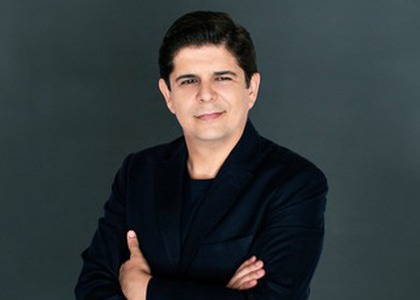
Interview with pianist Javier Perianes
The Spanish pianist Javier Perianes is the soloist of the December 5th, 2025 concert at the Sala Radio, with conductor Manuel Hernandez Silva will be at the rostrum. The audience will be able to listen to Javier Perianes perform Frederic Chopin's Piano Concerto No. 1 in E minor. We'll be listening to an interview where the musician talks about his second appearance on stage in Romania, as well as his general artistic activity. This interview was conducted by Ana Sireteanu.
With what thoughts are you returning to Romania and what are your expectations from this new collaboration with the National Radio Orchestra, as well as with the conductor Manuel Hernandez Silva?
I'm very glad to return as a soloist together with the National Radio Orchestra! I played with the ensemble in 2018 at the International Radio Orchestras Festival, where I played Ravel's Piano Concerto in G major. That was a wonderful experience that I had in Romania. I'm excited for the upcoming second collaboration with the ensemble, because I'll meet conductor Manuel Hernandez Silva again. I played many concerts together with him and I'm very proud to say that we have a beautiful friendship and a special, tight connection on a musical level.
Do you know any Romanian performers?
How could I not know Romanian performers?! One of my role models has always been pianist Radu Lupu. Of course there are many other examples of extraordinary Romanian performers, but, as a pianist, whenever someone mentions your country, I inevitably think of the amazing figure that is Radu Lupu, this prodigious artist, a titan, a giant of piano. So I greatly admire Romanian art and especially the piano legend that is Radu Lupu, in my opinion.
Even though it's a difficult question, which requires an outside look at your own artistic persona, I'd ask you to tell us what the traits that represent you the best as a pianist are and which are the main objectives that you would like to reach in the music that you make?
It's a very difficult question because a person can't define themselves. This is very hard to understand, because you, as an artist, can't witness your own art. As for me, I prefer to let the audience decide if they like my performance or not. The only thing I can say about myself is that I'm a musician who loves what he does. For me, music isn't a job, but the way I see the world, and what I'm trying to do is to perform every piece as if it was the best musical piece that exists at that moment, and I try to do this honestly and with dedication. That's all I can say about myself. The rest, the quality of the performance and the sound, the technique, I leave these things up to the audience. They're the only ones who can judge them.
The most important thing to me is to be honest towards the composer and especially towards the music that I play. I don't add anything false or superficial to my music, I don't add anything that I don't feel. What bring me the most satisfaction in what I do is working on the pieces I'll perform. Of course, the concerts are fantastic because you have the possibility of sharing the music with the audience that's in the room with you, this is the artist's mission, but, for me, the greatest satisfaction of my vocation in this life, which is music, is discovering a new piece before I go on stage, in front of the audience. For me, this is beautiful and special!
How would you describe the musical landscape of Spain and the cultural values of your country?
From a cultural point of view, Spain has developed enormously in the last 30 years. Of course, we've always had a good tradition and extraordinary musicians, such as Narciso Yepez, Pablo Casals, Alfredo Kraus, Placido Domingo and many others. In the last few years, however, various administrations in my country have started involving themselves more, leading to the founding of various new, and very good, orchestras. This creates an auspicious musical environment in Spain for the quality education of a new generation of musicians, and this has been proven over time. Today, we have very good musicians that represent us in some of the most important orchestras in the world, such as the Berlin Philharmonic Orchestra, the London Symphony Orchestra, or the New York and Chicago Philharmonic Orchestras. SO, we can be proud of the work we do, but at the same time, we have to continue to invest time and resources into music and art in general to continue to give the world talented people who will go and perform in these wonderful orchestras as well as, naturally, Spanish ensembles.
How would you describe the public's interest for classical music in Spain?
I'd say that it differs depending on the region you're in. Of course, Madrid, Barcelona, Valencia, Seville, Bilbao are some of the most important cultural centers. We're talking about big or medium-sized cities where classical music concerts are often sold out, like in the case of the Spanish National Orchestra in Madrid. Here, in Madrid, important concert nights are hosted, such as the Musica, where you can listen to some of the best orchestras in the worlds, and the concert halls are usually nearly full. So, I can say that after the pandemic, musical life in general and classical music specifically are resuming their course in Spain. But, of course, I don't perform in my own country very much, I have more concerts and recitals in other European cities, in the United States, in Australia, Asia, so I'm probably not the best artist to explain what things are like in Spain because I'm not very active in that musical space. But the feeling I have regarding this matter is that, in Spain, the concert halls are starting to fill up again with people who haven't been attending in the past few years, after the pandemic.
Translated by Alexandra Teodora Ciolacu,
University of Bucharest, Faculty of Foreign Languages and Literatures, MTTLC, year II
Corrected by Silvia Petrescu


