



> Interviews
Interview with Oana Boca Stănescu, about the series of events dedicated to Clara Haskil
In 2025, it will be 130 years since the birth of Clara Haskil. Between the 11th and 16th of December, a series of cultural events in Bucharest will shine the spotlight once more on the figure of the legendary pianist, considered one of the greatest woman pianists of the 20th century.
I know you were involved in other projects dedicated to the memory of Clara Haskil before. How did the initiative for the events that will take place in Bucharest between the 11th and 16th of December come to be?
First of all, I'm thankful for the interest you're showing for the series of events we're organizing now, in December, on the 130th anniversary of Clara Haskil's birth!
I'm a person who has been living and breathing in the cultural world since finishing college. Sure, I grew up in the zone of written culture, but my biography also includes 8 years of violin studies and a closeness to classical music.
The series of events is about Clara Haskil, about her music, but it also has a lot to do with memory and the neighborhood I live in, where she was born and where she started her musical journey: the Jewish Quarter, which I love.
Clara Haskil was born in Bucharest 130 years ago, but she ended up living in Switzerland and died with dual citizenship, Swiss and Romanian. So, our first gesture was to extend an invitation to the Swiss Embassy to move forward with this project. Switzerland participating in this project was the healthiest gesture possible. Afterwards, what wiser decision could there be than to try and come up with something that would take place at the New Europe College, whose rector is the musicologist, pianist and professor Valentina Sandu-Dediu? This way, putting these first few energies together, we came up with the round table scheduled for December 11th, 5 PM, at their headquarters on Plantelor Street, no. 21.
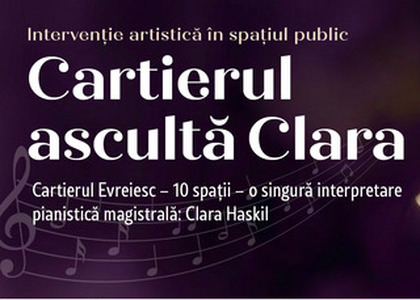
Like I said earlier, the Quarter fascinates me. Clara Haskil was born on a street here and the house doesn't exist anymore, but she lived at other addresses as well, with her uncles. So, because she had, let's say, such a spread out living arrangement, we thought we could symbolically bring her back to the neighborhood. This symbolic return led us to an event we called "The Quarter Listens to Clara". We will play her performances on the same day, at the same time, in 10 different places. This will be on December 11, at 1 PM.
These 10 places are a list that brings together public institutions, like the State Jewish Theatre or the National Library of Romania, as well as spaces where people just go for a coffee, and I'm glad we're reaching people who might not know Clara Haskil existed at all.
We've already started advertising and we hope people will actually come and participate in this community project. And in this shared memorial project, everyone who took part in the events will also have materials about Clara Haskil, because this is important.
Finally, the third event is a film screening, we managed to bring that well-known documentary to Bucharest, a France-Switzerland co-production, from the Arte portfolio, with the help of the Swiss Embassy. The screening will have free entry on December 16, from 6 PM, at the Cervantes Institute in Bucharest.
Why the Cervantes Institute? First of all, because they said "Yes" to our request without hesitation. But let's not forget, Clara Haskil was born 130 years ago in Bucharest to a family of Sephardic Jews. For years, the Cervantes Institute has been including projects dedicated to Sephardic culture.
From what you know, how often is Clara Haskil brought to the attention of the public?
Very rarely, that's obvious. I know grown adults with a healthy cultural profile who don't know very much about her existence. So I'd venture to say, even though I don't have data or research, much too rarely, and that's a shame, because Switzerland has a Clara Haskil cult. There are countless cities with a street named after her, there's the famous piano competition that bears her name, there are squares, so it's a living, present name in the minds of culture lovers.
On the other hand, let's not forget that Switzerland has Musical Education in its Constitution. So, in a way, things work logically, and it's a beautiful logic.
What sort of themes will be addressed during the round table that will open the series of events dedicated to Clara Haskil?
We called it: "Clara Haskil. The music of inner truth". It's going to be a round table and a concert. Valentina Sandu-Dediu will be moderating and joining us at the event will be musicologists Lena Vieru Conta, Ștefan Costache, Monica Isăcescu Lup and Irina Nițu, as well as architect Yvonne Toader, who is vice-president of the Order of Architects in Bucharest and a person who is passionate about the Jewish Quarter. She's conducting research in this architectonic space, so the discussion will not remain an investigation, a dialogue about pianist Clara Haskil and that's it, it will be a reflection on the figure, a discussion about memory, more so than a discussion for musicologists. Because we need this kind of exercises in interrogation and maybe being forgotten isn't just an injustice to her exceptional destiny, but also a loss for our culture itself, because we need role models and Clara Haskil is a model of rigorousness, sensibility and artistic expressivity. She's not necessarily a model in the area of music, but a human character, if you will, an artist of fragility and musical truth.
Returning to the beginning, what motivates you in this endeavor that commemorates Clara Haskil?
I told you that I'm fascinated in equal measure by Clara Haskil, as well as the stories that exist in the Quarter. And maybe that's the legitimacy brought on by this initiative and my involvement in this project, as the person that started these commemorative moments.
The accent is on memory, reclaiming it, and what we can do from now on to stabilize the figure of Clara Haskil into the portfolio of authentic cultural memory.
As for the Quarter, for me, it's a narrative site that's as fascinating as it is complicated, because it's a historical neighborhood, but I think it's one of the most animated spaces there are. It's all the more fascinating that in this journey and with the efforts to organize these events, I ended up discovering a house Clara Haskil lived in, one of her uncle's houses. Now I'm in touch with the owners, they want to open the house to everyone who want to come on the 11th, because they're also involved in the "The Quarter Listens to Clara" project, for people who want to go in and listen to one of Clara Haskil's performances in a house she actually played in while she lived.
Translated by Alexandra Teodora Ciolacu,
University of Bucharest, Faculty of Foreign Languages and Literatures, MTTLC, year II
Corrected by Silvia Petrescu


