



> Interviews
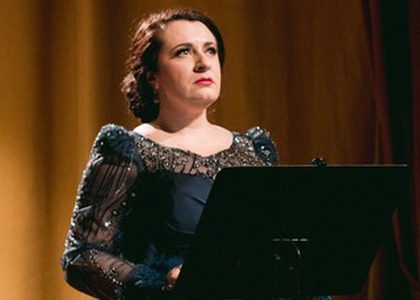
Interview with soprano Rodica Vică, about the BrancuSING International Tour
The BrancuSING International Tour is currently taking place, dedicated to celebrating the 150th anniversary of the birth of the sculptor Constantin Brâncuși. Organized by the InoMusicArt Association, with the support of the National Cultural Fund Administration, the project proposes a meeting point between music, heritage, and art history, inspired by the creative universe of Constantin Brâncuși. More details are shared by soprano Rodica Vică, the initiator of the project, in a dialogue with Ioana Țintea.
You mentioned in an online post that major projects are built from people, from encounters, from that "yes" said at the right moment. How did the idea of singing the universe of sculptor Constantin Brâncuși come about?
The idea did not emerge as a project concept, but as an inner need that gradually became clearer over time.
In my relationship with music and the stage, I have always sought a deeper meaning of expression, beyond interpretation, and my encounter with Brâncuși's universe came naturally, almost inevitably. I felt that his sculpture already contains music, breath, an inner rhythm that only needs to be heard differently. To evoke Brâncuși through music does not mean to illustrate, but to translate his artistic essence into sound - or at least that is our intention.
Everything essentially started from the desire to find the sonic equivalent of form, of simplicity taken to its limit, of that balance between matter and spirit. It was, therefore, a "yes" to an intuition that was later shaped through encounters, study, and genuine dialogues.
The project is based on interdisciplinary research carried out together with art historian Doina Lemny from France. How did you build this dialogue between music and art history?
Of course, the dialogue with Doina Lemny was essential in grounding this intuition in a solid understanding. We did not start from the idea of explaining Brâncuși through music, but of creating a shared space between two languages.
We worked from very concrete concepts in his sculpture, such as rhythm, repetition, variation, or reduction to essence, and in parallel we searched in music for those structures that could support these ideas without oversimplifying them. This is how a genuine dialogue was born-not a decorative one-in which music does not accompany and art history does not explain, but both open up a new perception.
The concert-talk format arises precisely from this need to give the audience space to understand without being rigidly guided.
What new things did you discover about Brâncuși in this process, beyond the already established image of the great Romanian artist?
I discovered a much more vivid Brâncuși than the one I knew from school textbooks. An extremely complex artist, highly attentive to sound, vibration, even silence. I was surprised to discover how musically he thought about form. Repetition was never mechanical; it felt as if it breathed, just like a musical phrase. And perhaps most importantly, I came to better understand his relationship with simplicity-not as reduction, but as a concentrated form of meaning.
In this process, Brâncuși no longer appears only as a sculptor, but as a creator of spaces, of perception, and music can enter these spaces without disturbing them.
Let us turn to the concert program of the tour, which brings together works by Erik Satie, Anton Pann, George Gershwin, and Augustín Lara, as well as two contemporary creations. What can you tell us about the two song cycles created especially for the BrancuSING tour by Sabina Ulubeanu and Radu Mihalache?
The concert program is conceived more as a journey than as a sequence of musical works. That is why the association of Erik Satie, Anton Pann, George Gershwin, or Agustín Lara is not accidental. Each brings a different relationship to simplicity, line, and essence.
The two contemporary cycles composed specifically for this tour, by Sabina Ulubeanu and Radu Mihalache, form the living core of the project. They do not necessarily illustrate Brâncuși, but certainly start from the natural question: how do you translate a form into sound without explaining it?
In Sabina Ulubeanu's work, for example, the language is more fragmented, with a fine attention to texture and space, while in Radu Mihalache's case the discourse has a more evident narrative coherence, yet maintains the same tension between the concrete and the abstract. Both song cycles expand the Romanian vocal repertoire in a direction that is absolutely necessary, deeply connected to the present.
After the concerts already held in Bucharest, Târgu Jiu, Vienna, and Budapest, what follows on the tour map?
The tour continues with stages in Rome, Madrid, Porto, Paris, and will conclude in New York. Each city brings a different context, and implicitly a different relationship with the audience. For me, it is also interesting to observe how the same concept subtly transforms depending on the space and the energy of the place. In some places, the dialogue becomes more analytical, while in others it feels more intuitive.
Thus, this second part of the tour is about consolidation-not only of the project itself, but of the way it can exist in different cultural contexts without losing its identity.
Translated by Ioana Nicolescu,
University of Bucharest, Faculty of Foreign Languages and Literatures, MTTLC, year II
Corrected by Silvia Petrescu


