



> Interviews
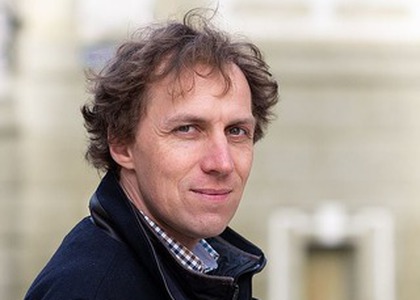
Interview with organist Steffen Schlandt
On April 1st, 2026, at 8:00 PM, the Holy Week concert will be held at the Roman Catholic Church "Holy Apostles Peter and Paul," conducted by Steffen Schlandt and performed by the "Capella Coronensis" Ensemble, the "Bach" Choir, and the two invited soloists, Orsolya Lövenberger and Nicolae Simonov. More about this concert is shared by organist and conductor Steffen Schlandt in an interview given to Teodora Ion:
The program of the April 1st concert at the Roman Catholic Church "Holy Apostles Peter and Paul" features Part II of the oratorio Messiah by Georg Friedrich Handel, along with the motet Der Gerechte kommt um by Johann Sebastian Bach. What led you to choose these works?
The theme of Holy Week has varied greatly over the centuries, ranging from a week without music in extreme cases to a climax-usually Good Friday-which, for us in the Lutheran Church, is the moment when we can perform Bach's great Passions, such as the St Matthew Passion or the St John Passion. This year we chose a different, intermediate approach, combining Part II of Messiah by Georg Friedrich Handel with a motet by Bach. We felt that this text by Johann Kuhnau and Johann Sebastian Bach fits very well with the point reached in the Messiah oratorio-namely, the moment of the crucifixion and death. We therefore created a kind of structure, and before Handel we will perform a concerto grosso by Handel, so that the works are connected by a common thread. To frame the program, we will perform at the beginning and at the end-once as an organ arrangement and once in a choral version-a chorale for Holy Week ("O Man, Bewail Thy Grievous Sin"), so that the evening's program resembles a liturgical service, with a prelude, a postlude, and a more substantial central section, much like the sermon in a service.
How is your collaboration with the two soloists, alto Orsolya Lövenberger and tenor Nicolae Simonov?
They have long been close collaborators-Orsolya is also a member of the choir, and Nicolae Simonov frequently works with us, sometimes even singing within the choir. They are soloists we work well with, especially in the field of Baroque music. German pronunciation is very important, as is stylistic accuracy. In Baroque music, voices must be very clear, intelligible, and agile in coloratura passages, and of course we strive to develop together with these soloists in order to interpret the Baroque repertoire as authentically as possible.
You have experience working with both the "Capella Coronensis" Ensemble and the "Bach" Choir. What are the main challenges you identify in coordinating these two ensembles in a joint project?
These are two somewhat different ensembles. Capella Coronensis is an ensemble made up of professionals-members of the Brașov Philharmonic. The Bach Choir, on the other hand, is quite heterogeneous: some members have completed music studies, but most have not. Blending them into a single ensemble is a challenge, because we must ensure a very homogeneous and unified sound, as if it were one choir, despite their different professional backgrounds. We therefore use various methods to support those without formal musical training- to better learn the notes, respectively, computer-assisted tools that allow each singer to learn their individual part, as well as sectional rehearsals.
What other projects are you preparing after this concert?
This year we still have two projects scheduled. At the beginning of July, we will have a summer concert together with the Brașov Philharmonic, where we will prepare Messe solennelle de Sainte Cécile by Charles Gounod. It is a work we have not performed before, and we are very curious to explore it. At the end of the year, we will prepare the first part of the oratorio Messiah, which focuses on expectation and Advent and then the birth of the Lord. These are the upcoming projects with which we hope to delight the audience in Brașov.
Translated by Sorana Dumitrescu,
University of Bucharest, Faculty of Foreign Languages and Literatures, MTTLC, year II
Corrected by Silvia Petrescu


