



> Events
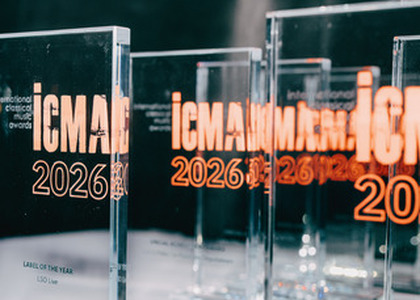
Travel Diary – International Classical Music Awards Gala 2026 in Bamberg
Since 2021, spring has also meant, for me, the International Classical Music Awards (ICMA) Gala, where I have been a jury member since December 2019 (the 2020 gala had been scheduled to take place in Seville, but it was cancelled due to the COVID-19 pandemic). Vaduz (2021), Luxembourg (2022), Wrocław (2023), Valencia (2024), Düsseldorf (2025), and Bamberg (2026) have hosted the ICMA galas, and in 2027, for the first time in the history of these awards-often referred to as the "Oscars of classical music", the gala will be held in Romania. On April 9th, 2027, the event will take place in Cluj, organized by the "Transilvania" Philharmonic, with Radio România Muzical as co-producer and official audio broadcaster.
Behind the Scenes of the ICMA Jury
The day of the gala is always special; however, I think it might be a good idea to give you a glimpse of what happens before the gala, which is only the tip of the iceberg when it comes to the work of the ICMA jury. For the 2026 edition of the awards, the jury received approximately 400 productions (CDs and DVDs) released between November 1st, 2024, and October 31st, 2025. By the end of October 2025, each jury member had to nominate 10 of their preferred titles in each of the 16 categories - 14 audio and 2 video. A production proposed by at least two jury members was considered officially nominated by the jury and announced as such; this was followed by three further rounds of voting - each jury member votes independently, assigning points to each production - to determine the finalists and, ultimately, the winner in each category. Then, a production is proposed and jointly agreed upon as the Album of the Year - for 2026, this was Shostakovich Discoveries, featuring a larger line-up that also includes the Romanian pianist Daniel Ciobanu.
However, the awards for audio and video productions are not the only ones granted by the ICMA jury; there are also around ten special awards. Some of these are proposed by jury members and then voted on-such as Young Artist of the Year and Composer of the Year. The Discovery Award and the Claseek Young Artist of the Year-two further prizes for young musicians-are proposed by ICMA partners (the Swiss platform Claseek and the Liechtenstein Academy) and voted on by the jury. Lifetime Achievement and Artist of the Year are proposed by the jury board. All musicians selected for the special awards are required to be present and to perform at the Winners' Gala.
I would also like to recall that in 2022, the Composer of the Year was Sebastian Androne-Nakanishi, and in 2024, the Young Artist of the Year was the soprano Aida Pascu-both of whom were nominated by me in my capacity as a Romanian member of the jury.
Bamberg
All jury members look forward each year to the ICMA Awards Ceremony and Gala Concert-it is the confirmation of the work carried out over the course of a year and, more than that, it is also a validation of the work of a music journalist in general: all jury members, representing 20 publications and radio stations from across Europe, are specialized music journalists, and if there is one thing that sets the ICMA jury apart, it is precisely this strictly professional selection, free from any marketing interference. In fact, I recall from this year's speech by the jury's president, Rémy Franck, editor-in-chief of the respected Luxembourg-based publication Pizzicato, that these awards honor productions which still address the higher emotional and intellectual dimensions of the human spirit, rather than those aimed solely at entertainment.
On March 18th, 2026, the ICMA Gala was hosted by the Bamberg Symphony Orchestra, a prestigious ensemble celebrating its 80th anniversary on this occasion and also receiving a special ICMA award for its achievements. Today, the Bamberg Symphony Orchestra is considered one of Germany's finest orchestras, with a career encompassing season concerts, recordings, tours, and a legacy shaped by renowned conductors throughout its history. For the past ten years, the chief conductor has been the Czech Jakub Hrůša, who was named Performer of the Year at the 2026 ICMA Gala. A widely beloved artist, he also received on this occasion Bavaria's highest cultural distinction.
The awards gala consists of two main moments: the presentation of the prizes and the gala concert. Over the course of two hours, the jury president, Rémy Franck, and Nicola Catto, the jury secretary, delivered laudations during the awards ceremony and kept the atmosphere lively, while we, the jury members, presented the prizes. I personally awarded the prizes for the Premieres Recordings and Video Opera categories.
The awards ceremony opened with a festive and moving moment dedicated to the hosts. Taking advantage of the presence in the audience of the renowned American soprano Melody Moore, now based in Cluj, we all sang "Happy Birthday" to the Bavarian orchestra alongside her.
One by one, the musicians and representatives of the record labels took the stage to receive their awards and to express their thanks or share a few words. There was also a musical interlude performed by the pianist Andrei Korobeinikov, who appears on the Shostakovich Discoveries album. I also noted Jakub Hrůša's encouragement to view recorded productions as a means of promoting live concerts in the concert hall. I was delighted at the end when representatives of the "Transilvania" Philharmonic in Cluj, Silvia Sbârciu (manager) and Loredana Vălean (marketing director), presented a video about Cluj, the future host of the ICMA Awards. The video inspired many in the audience to plan a visit next year, to see that Romania is truly much more than just Dracula's country.
Gala Concert
At 8:00 p.m., the gala concert began in the beautiful hall of the Bamberg Symphony Orchestra, a modern building inaugurated in 1993. The event was recorded by the Bavarian classical music station BR Klassik, with one of their presenters hosting. Deutsche Welle provided a live audio-video broadcast on its YouTube channel, and the recording can be viewed here.
At the concertmaster's rostrum was the Moldovan violinist Ilian Gârneț. Now 43 years old, Gârneț won third prize in 2009 at one of the most demanding violin competitions in the world, the Queen Elisabeth Competition in Brussels. He has been the concertmaster of the Bamberg Symphony Orchestra for eight years, which already speaks volumes about the quality of the orchestra.
Symbolically, the musical program both opened and closed with two works by Beethoven. On March 20th, 1946, at the orchestra's inaugural concert, the same two pieces were performed: the Leonore Overture No. 3 and the final movement of the Seventh Symphony. Especially in the overture, the orchestra demonstrated its exceptional quality: homogeneity, unity in attack, musical intelligence-a compact yet highly flexible organism whose sound filled the hall and whose powerful message reached every person in the packed audience. The conductor throughout the entire concert was Jakub Hrůša, a conductor deeply beloved by his orchestra, both efficient and profoundly musical.
We then listened to the violist Nils Mönkemeyer in the first movement of Béla Bartók's Concerto for Viola and Orchestra. Monkemeyer is featured on the Shostakovich Discoveries album, which won the 2026 ICMA in the Premiere Recordings category and the title of Album of the Year.
The program continued with two excerpts from the oratorio Passio by Peter Zombola, Composer of the Year 2026. Aged 43, Zombola is currently a professor at the Franz Liszt University in Budapest. He is particularly interested in monumental works in the vocal-symphonic genre; his music remains within the realm of consonance-a meditative reflection on themes of importance to humanity.
As Record Label of the Year, LSO Live, the label of the London Symphony Orchestra, featured the LSO concertmaster Roman Simović performing the third movement of Tchaikovsky's Violin Concerto-a rendition full of energy and, I would say, with a touch of humor.
In the Contemporary Music category, one of the two winners was an album featuring music by the Finnish composer Kalevi Aho. Two pieces, with Sharon Bezaly on flute and Hiyoli Togawa on viola, highlighted this award.
Discovery Award in 2026 went to the violinist Mariam Abouzahra. At 17 years old, she was born in Germany to parents from Hungary and Egypt-an intriguing artistic profile. However, she still has room to grow as an artist in order to perform Brahms' Violin Concerto at a high level; she performed the third movement of the concerto at the gala.
In the Concertos category, the ICMA went to an album by the Italian pianist Roberto Prosseda, featuring rarely performed works from the Italian repertoire-such as the Piano Concerto by Silvio Omizzolo. At the gala, a portion of this concerto by the composer, who lived from 1905 to 1991, was performed-a music that certainly deserves to be explored further.
The Vocal Music category was represented by the winner of the category, the Albanian soprano Ermonela Jaho. The album features songs by Gaetano Donizetti, Volume 5 of the Opera Rara series. At the gala, Ermonela Jaho and Roberto Prosseda performed Lamento per la morte di Bellini.
One of the highlights of the gala was the performance by the vocal ensemble Amarcord, which won the ICMA in the Early Music category. Often described as the German counterpart of the renowned The King's Singers, Amarcord performed a five-voice motet by Josquin des Prez and a German folk song-an ensemble with beautiful, highly expressive voices, strong stage presence, and remarkable authenticity.
The Claseek Young Artist of the Year, pianist Anthony Ratinov, performed the final movement of Tchaikovsky's Piano Concerto No. 1. An American artist of Russian descent, Ratinov is the laureate of several major international competitions; however, he had never performed Tchaikovsky's concerto before, and this was noticeable at the gala.
The Beethovenian finale, with the last movement of Beethoven's Seventh Symphony, was fitting and celebratory, closing a nearly three-hour gala concert on a note full of enthusiasm. I would like to congratulate the organizers here-everything took place in an atmosphere of professionalism and cordiality, qualities that seem increasingly rare today.
Close to midnight, I crossed the Regnitz River on my way back to the hotel-and I thought once again how beautiful a river looks when nature thrives along its banks, lined with vegetation and free from concrete. Bamberg remains one of Germany's most enchanting cities, preserving the beauty of its medieval heritage and Bavarian character, including the "Little Venice" along the Regnitz. Everything feels authentic, as Bamberg was spared from the bombings of World War II.
From the charm of Bavaria to that of Transylvania - in 2027, on April 9th, we will meet again in Cluj, live on Radio România Muzical, at the International Classical Music Awards Gala!
Photo: Marian Lenhardt
Translated by Ruxandra Ioana Șerban,
University of Bucharest, Faculty of Foreign Languages and Literatures, MTTLC, year I
Corrected by Silvia Petrescu


