


Disk of 2024
Jean-Baptiste Lully - Atys - Opera, a world, 29th of March 2026
Jean-Baptiste Lully - Atys - Opera, a world, 29th of March 2026
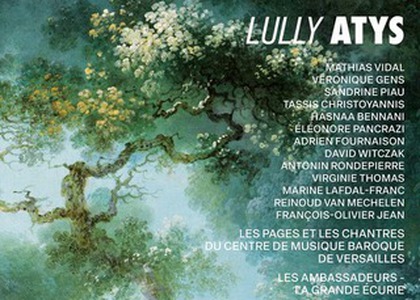
Jean-Baptiste Lully - Atys, with: Mathias Vidal, Véronique Gens, Sandrine Piau, Tassis Christoyannis, Hasnaa Bennani, Eléonore Pancrazi, Adrien Fournaison, David Witczak, Antonin Rondepierre, Virginie Thomas, Marine Lafdal - Franc, Reinoud Van Mechelen, François - Olivier Jean; the Choir of the Baroque Music Centre of Versailles - Les Pages et les Chantres (prepared by Fabien Armengaud) and the Ensemble Les Ambassadeurs - La Grande Écurie, conductor Alexis Kossenko.
Today we're listening to the opera Atys by Jean-Baptiste Lully. A recording released by Alpha on the 30th of January, the album is included in the Discs of the Year 2026 project; we are broadcasting it for the first time on our station. The recording was made in March 2024 at the Salle Colonne in Paris, alongside a series of concerts with the same title.
A musical tragedy composed in 1676, consisting of a prologue and five acts with a mythological theme, Atys has a libretto written by Philippe Quinault, inspired by Ovid's Fasti. First performed at the court of The Sun King, Louis XIV, the opera Atys was particularly beloved by the monarch. As we know, the glory of Baroque creations faded with the emergence of other musical styles, only to be rediscovered and celebrated centuries later. This year marks four decades since the first revival of the opera Atys, which was immediately regarded as a masterpiece of Lully's compositions; this year also marks the 350th anniversary of the work's world premiere.
What is the merit of this new recording? Well, we live in an era where the passion for interpretations based on meticulous historical and musicological research brings to light new information that results in sounds that are different from previous recordings of the same score. In this case, it was the studying of manuscripts from Versailles and Colmar, the latter having been discovered in 2023. An endeavor we owe to Benoît Dratwicki - Artistic Director of the Baroque Music Center of Versailles - and to conductor Alexis Kossenko. We can now say that the opera Atys is performed as closely as possible to the way it was performed in Lully's time. The orchestra is positioned facing the soloists, with the audience behind them and surrounding the conductor; in this way, they interact visually with the singers.
The ballet sections are accompanied by separate groups of musicians who enter and exit the stage (in the past, they too wore costumes, becoming part of the visual concept). The wind and percussion players are exclusively on the stage and not in the orchestra pit, as in Lully's time the dancers themselves played these instruments. The continuous bass is consistent, because it must be clearly audible to the singers to ensure intonational accuracy and rhythmic precision. They even went so far as to create replicas of period oboes, using the instruments preserved at the Paris Museum of Music as models; in Atys, they represent the zephyr, their role being to provide timbral colour to the musical sequences. The choral groups also benefit from judicious distribution, with the children's choir being distributed in such a way as to serve timbral diversity. And since Lully did not like excessive ornamentation, Alexis Kossenko took care to reduce it significantly compared to current practice. It all culminated in the selection of the soloists, choosing those who had vocal characteristics similar to those in 1676. Thus, a titanic effort went into this new production.
Among the numerous performers, we will watch the following in the leading roles: tenor Mathias Vidal - in the title role of Atys, a relative of Sangaride and a favorite of Célénus; soprano Véronique Gens - the goddess Cybèle; soprano Sandrine Piau - the nymph Sangaride, daughter of the river god Sangarius; and baritone Tassis Christoyannis - Célénus, King of Phrygia and son of Neptune, in love with Sangaride. In secondary roles: soprano Hasnaa Bennani as the nymph Doris, friend of Sangaride and sister of Idas; mezzo-soprano Éléonore Pancrazi as Melpomène, the tragic Muse, and also as Melisse, confident and priestess of Cybele; bass-baritone Adrien Fournaison as Idas, friend of Atys and brother of Doris, but also as Phobétor, son of Sleep; baritone David Witczak - in three roles: Time, the Dreadful Dream, and the River God Sangar (Sangarius), father of Sangaride; tenor Antonin Rondepierre in three other roles: Zephyr, Morphée, son of Sleep, and A Spirit of the Rivers; soprano Virginie Thomas -Flore, the goddess of spring, and also A Fountains Spirit; soprano Marine Lafdal-Franc - the goddess Iris, and also A Fountains Spirit; tenor Reinoud Van Mechelen - the God of Sleep; and tenor François-Olivier Jean - Phantasm, son of Sleep. Episodic roles are performed by sopranos Constance Palin and Madeleine Prunel - spirits of the fountains; tenor Carlos Rafael Porto - A Spirit of the Rivers; soprano Marie Baron and baritone Henri De Montalembert - spirits of the streams. It would take a considerable amount of space to discuss each one individually. Briefly, the performers are exceptionally harmonious, impeccable, and perfect for this work. Compliments go to the entire ensemble of soloists, as well as to the creators of this project - Benoît Dratwicki, Artistic Director of the Baroque Music Center of Versailles, and conductor Alexis Kossenko.
The wonderful choir, which includes both adults and children, is that of the Baroque Music Center of Versailles, Les Pages et les Chantres, led by Fabien Armengaud. Joining them is the prestigious ensemble Les Ambassadeurs - La Grande Écurie, whose musical director is Alexis Kossenko; a conductor under whose baton Lully's opera is revealed to us as full of vigor, dynamic, brilliant, sometimes with dark accents, yet also lyrical, refined, and profoundly touching. Thus, full of colors and moods, serving the opera's subject matter in every way.


